Small Garage? Here’s How to Make It Look Bigger, Brighter, and Better
1. Use Bright, Even Lighting to Eliminate Shadow Zones
The fastest way to make a small garage feel even smaller is uneven lighting.
Most garages rely on a single light source, which creates:
- dark corners
- heavy shadows
- inconsistent visibility
These shadows visually “shrink” the space by breaking it into sections.
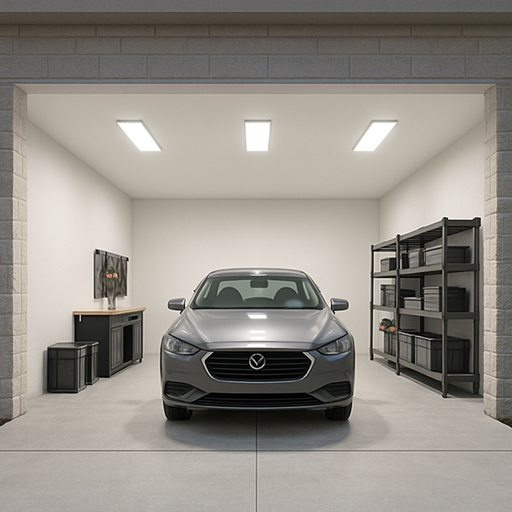
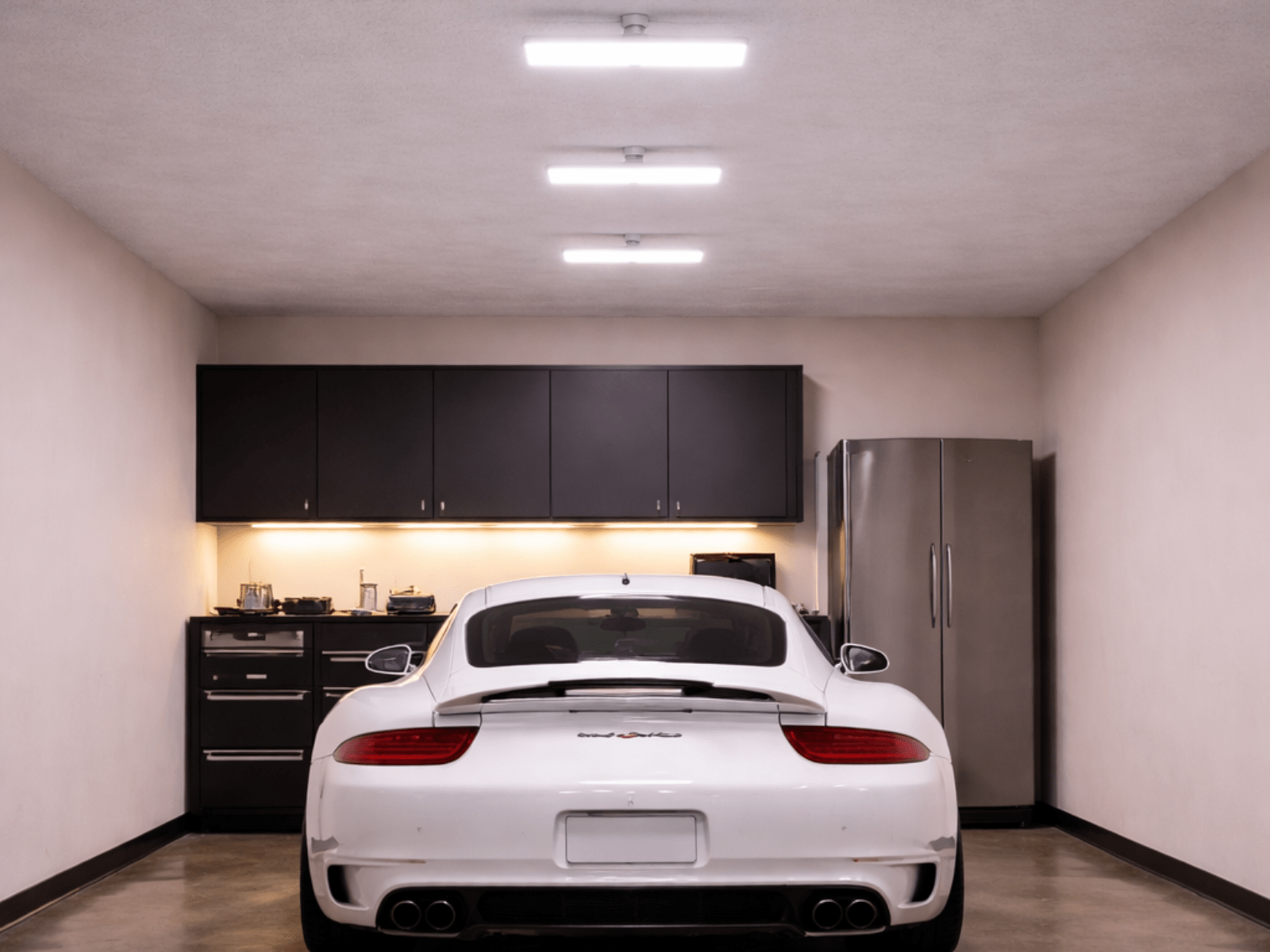
When lighting is evenly distributed across the ceiling, those shadow zones disappear—and the entire garage immediately feels more open.
Why this matters:
Your eyes interpret brightness as space. The more evenly lit the room is, the larger it feels.
How to approach it:
- aim for full coverage, not just brightness in one area
- eliminate dark edges and corners
- keep lighting consistent from front to back
Pro tip:
If your garage looks smaller at night than during the day, your lighting layout is the issue—not the space itself.
The foundation of any upgrade starts with strong garage lighting ideas, especially in smaller spaces.
2. Build Vertically (Not Outward)
In small garages, floor space is your most valuable asset.
One of the most common mistakes is using that space for storage—stacking bins, tools, and equipment outward instead of upward.
Why this matters:
Anything sitting on the floor reduces visible space, which makes the garage feel tighter and more cluttered.
What works better:
- vertical wall storage
- mounted systems
- keeping the floor as open as possible
Real impact:
When your floor is clear, your garage instantly feels larger—even if nothing else changes.
Pro tip:
If you can see more floor, your garage will always feel bigger.

3. Simplify Your Color Palette (Visual Noise Shrinks Space)
Color plays a bigger role in perception than most people realize.
When a garage has too many competing colors—tools, bins, walls, flooring—it creates visual noise, which makes the space feel chaotic and smaller.
Why this matters:
Your brain has to process more information, which makes the space feel crowded.
What works best:
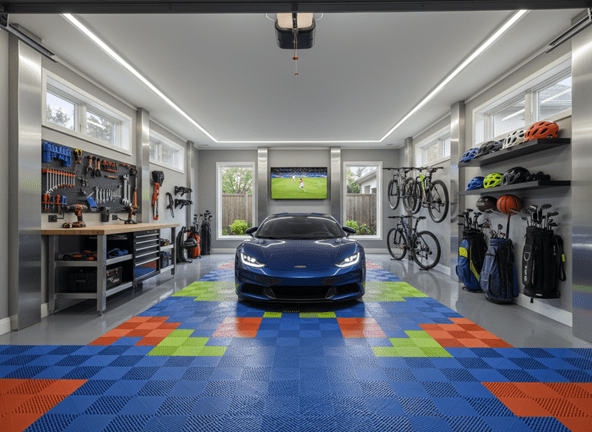
- neutral base tones (black, gray, white)
- minimal accent colors
- consistency across surfaces
Real impact:
A consistent color palette makes the garage feel calmer, cleaner, and more spacious.
Pro tip:
If everything stands out, nothing looks intentional.
4. Use Reflective Surfaces to Amplify Light
Lighting alone doesn’t determine brightness—your surfaces play a major role.
Matte, dark, or unfinished surfaces absorb light, while reflective surfaces bounce it back into the space.
Why this matters:
In a small garage, you need to maximize every bit of light you have.
What helps most:
- clean or coated floors
- smooth wall finishes
- organized, uncluttered surfaces
Real impact:
Reflective environments can make a garage feel significantly brighter without adding more fixtures.
Pro tip:
If your lighting feels underwhelming, your surfaces may be absorbing it instead of reflecting it.

5. Keep the Floor Open (This Changes Everything)
This is one of the simplest—but most powerful—garage space optimization strategies.
When the floor is crowded, the garage feels tight. When the floor is open, the garage feels larger.
Why this works:
Open floor space creates uninterrupted visual flow, which makes the room feel bigger than it actually is.
What to avoid:
- loose items sitting around
- bulky storage taking up ground space
- unnecessary equipment
Real impact:
Clearing the floor often makes a bigger difference than adding new features.
Pro tip:
Before buying anything new, remove or relocate what’s already taking up space.
Avoid these common garage design mistakes that can make a small garage feel even tighter.
6. Add Depth With Layered Lighting
Flat lighting makes small spaces feel boxed in.
Layered lighting—using multiple levels or angles—adds depth and dimension, which makes the garage feel more dynamic.
Why this matters:
Depth tricks your eye into perceiving more space.
How it works:
- overhead lighting for full coverage
- additional lighting to create contrast and visual separation
Real impact:
Instead of feeling like a single flat room, your garage starts to feel more expansive and designed.
Pro tip:
If everything is lit the same way, the space will feel flat. Variation creates dimension.
7. Design With Intent (Not Just Function)
Most small garages feel cramped because they’re designed only for function—not for how they look or feel.
A well-designed garage considers:
- spacing
- alignment
- visual balance
Why this matters:
Intentional design creates structure, and structure makes a space feel controlled and open.
What this looks like in practice:
- aligned storage
- consistent lighting layout
- clean, repeatable patterns
Pro tip:
A small garage that’s intentionally designed will always feel bigger than a large one that isn’t.
If you’re planning a full upgrade, this garage checklist will help you avoid many costly mistakes.

Final Thought
A small garage isn’t a limitation—it’s a design challenge.
And when it’s done right, it often ends up looking cleaner, sharper, and more refined than larger spaces.
In almost every case, the turning point comes down to how lighting, layout, and visual control are handled together.